
Florida's Harmful Algae Blooms: A Year-Round Freshwater HAB Problem: Cyanobacteria From January Throughout The Year

Florida 2026 freshwater harmful algae bloom season began in the first week of January, when state and county health officials started issuing cyanobacteria advisories for lakes and ponds across the state. By mid-May, dozens of freshwater bloom advisories spanned Florida lakes, canals, and rivers across many counties. The headline finding: Florida no longer has a summer freshwater bloom season. It has a year-round one.
This post walks through what the freshwater data shows, why these blooms now run twelve months a year, and what it tells lake managers, county health departments, and water-quality professionals about where biological treatment fits.
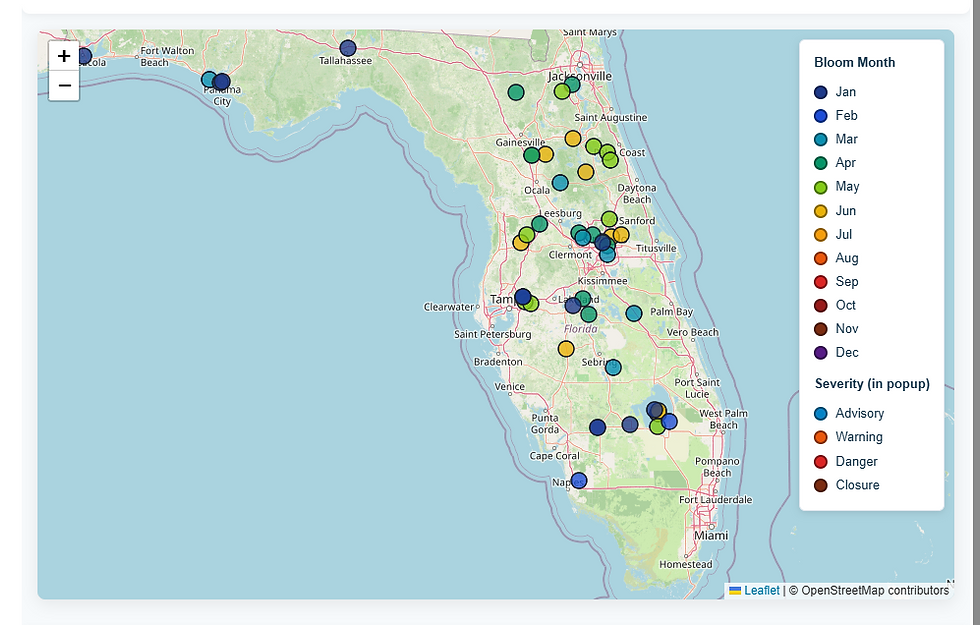
Florida's Harmful Algae Blooms: The January start
Florida freshwater bloom season started early. On January 6, the Florida Department of Health in Escambia County issued a health alert for Admiral Mason Park Pond in Pensacola. The same day, alerts followed for Lake Echo in Polk County, two sites in Lake Okeechobee, and Lake Thonotosassa in Hillsborough County. By mid-January, the Caloosahatchee system Sebastian Canal carried its first 2026 advisory. That pattern, inland cyanobacteria advisories in the first two weeks of January, used to belong to May or June. In 2026 it belonged to the first 14 days of the year.
What the freshwater data shows
Freshwater events were dominated by cyanobacteria, primarily Microcystis. Lake Okeechobee, the Caloosahatchee canals, Lake Thonotosassa, Lake Apopka, Orange Lake, and Lake Carlton each appeared more than once, signalling persistent bloom conditions rather than isolated incidents.
Recurrence was the rule, not the exception. Lake Thonotosassa registered alerts in January, February, and March. Orange Lake received its second alert in 30 days on May 6. The Caloosahatchee Sebastian Canal was issued, lifted, and re-issued within a single month.
County health departments were the source for the large majority of events. Florida per-county reporting infrastructure is one of the most active in the country, which is why the state freshwater bloom picture is so well documented.
Why year-round freshwater blooms are the new normal
Three structural factors keep Florida freshwater bloom season running. First, the nutrients. Phosphate, ammonia, and nitrate from agricultural runoff, urban stormwater, and aging septic systems do not pause for winter. South Florida sends sustained nutrient loading into Lake Okeechobee, which discharges through the Caloosahatchee system. The result is a continuous fuel supply for cyanobacteria across the freshwater chain.
Second, water temperature. Florida freshwater systems rarely cool enough to suppress cyanobacteria photosynthesis, so the seasonal brake that slows blooms farther north is largely absent. Third, hydrology. Canal systems like the Caloosahatchee concentrate nutrients in slow-moving water optimized for drainage and flood control, not for biological turnover, and Florida interconnected freshwater system moves bloom organisms across county lines faster than any single jurisdiction can respond.
What this means for treatment
Florida freshwater data underscores a mismatch between the problem and the dominant response. Algaecides treat the visible symptom by destroying algae cells. They do not remove phosphate, ammonia, or nitrate from the water. When the chemical wears off and the next nutrient pulse arrives, the bloom returns. That is the recurrence pattern visible across Lake Thonotosassa, Orange Lake, the Caloosahatchee, and Lake Okeechobee.
Hydralife takes the opposite approach. We cultivate beneficial freshwater phytoplankton that consume the same phosphate, ammonia, and nitrate that toxic cyanobacteria need. Through competitive exclusion, the principle that two organisms competing for the same limited resource cannot coexist indefinitely, our phytoplankton starve harmful algae of the inputs required to bloom. The result is a self-sustaining biological control that addresses the nutrient driver, not the symptom. In high-nutrient water, the conditions Florida already has, the approach works better, not worse.
Phosphate (PO4) reduction: 70 to 90 percent
Ammonia (NH4) reduction: 80 to 95 percent
Nitrate (NO3) reduction: 50 to 80 percent or higher
Phytoplankton growth: 21 to 54 percent per day
Because beneficial phytoplankton multiply at these rates while the nutrient supply lasts, one application can hold the bloom window open for much of a season. The product ships overnight in 5-gallon buckets to all 50 states at 20 dollars per gallon, with plans sized to water body, nutrient loading, and bloom history.
A note on the live HAB map
Florida freshwater events appear on the Hydralife HAB Map, a live national tracker of harmful algae bloom advisories updated daily. Every dot links to a county health department alert, a state agency advisory, or a federal closure notice, so you can verify it at the source.
Get in touch with Hydralife
If you manage a Florida lake, pond, or canal and you want a biological treatment plan that does not rely on copper sulfate or other algaecides, get in touch. Hydralife Solutions ships concentrated live beneficial freshwater phytoplankton overnight to all 50 states.
Website: www.hydralife.org
Email: rphilipsborn@hydralifesolutions.com
Phone: 303.219.0623
YouTube: @HydralifeSolutions


Comments