
Beneficial Phytoplankton, Proven in the Field: Measured Results From Real Ponds and Lakes

Updated: Oct 11
A fair question comes up whenever a water treatment method is new: is it actually proven, or is it just a good idea? For Hydralife's beneficial phytoplankton, the answer is written in the water chemistry of real ponds and lakes. This is our field record: named clients, baselines and follow up nutrient readings, independent laboratory confirmation, and outcomes documented across a full growing season. The results below come from municipal park lakes, golf course irrigation ponds, and private ponds in Colorado and Ohio. Our approach is showing real results and we would like to be of assistance to more lake managers and bodies of water.
How the method works
Hydralife produces live concentrated beneficial phytoplankton. This phytoplankton consumes nitrogen and phosphorus in ponds, lakes, and reservoirs. Every species we grow is chosen against the same criteria: high nutrient uptake, common presence in United States freshwater, excellent food source for zooplankton, they improve dissolved oxygen levels, they all utilize luxury uptake (the ability to consume and store more phosphate than they need to grow), they have high daily growth rates when the conditions are right and they live in a subtropical temperature range which causes the population to crash on its own as water cools and daylight drops. These are freshwater green algae of the kind already found in lakes and ponds across the country. Our photobioreactor lets us isolate species and build regional combinations, so a treatment can be matched to what already lives in the target water rather than introduced to it.
This approach uses natural phytoplankton instead of chemical treatments like copper, peroxide or algaecides. Our phytoplankton self propagates throughout the entire grow season, once it establishes itself. It is built for nutrient rich water or for lakes that could use a boost of good phytoplankton. Simply stated, the beneficial phytoplankton (good algae) competes with bad algae for nutrients and challenges bad algae development.
How to read the numbers
Every value below is in parts per million (ppm). Our results have been confirmed by an independent laboratory and university. Ammonia (NH4) is the most toxic nitrogen form and a primary food for the phytoplankton. Phosphate (PO4) is the nutrient most closely tied to harmful algal blooms. Phosphate is known as the "limiting nutrient" since cyanobacteria must pull it from the water column in order to develop. When a pond is fed by an inflow, the clearest proof is the gap between the nutrient rich water coming in and the far cleaner water in the pond, which shows the phytoplankton consuming nutrients as they arrive.
Ravenna Country Club: a platinum country club with lab-verified results
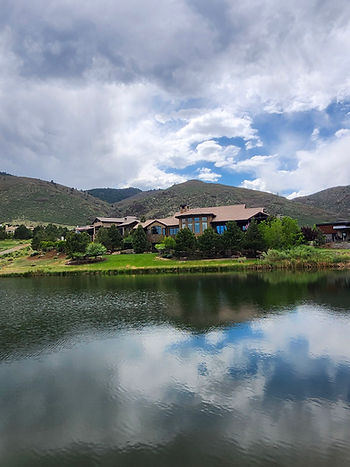
At Ravenna Country Club near Littleton, Colorado, their irrigation pond is refilled each night with roughly hundreds of thousands of gallons of nutrient rich effluent water from Castle Rock wastewater treatment facilities. Ravenna's Director of Agronomy, Steve Datwyler, is always looking for better techniques to improve his course, turf, irrigation programs, water management and his guest experience. After a single 100 gallon inoculation of concentrated phytoplankton in the spring of 2026, ammonia in the irrigation pond fell from 1.0 ppm to under 0.25 ppm in just a couple of weeks, and phosphate dropped to a barely detectable level. From there, all of Steve's phosphate and dissolved nitrogen levels fell to barely detectable levels and they held at those levels through the spring, summer and fall seasons. For the first time in six years, Datwyler observed no surface filamentous algae on the pond, fewer aquatic plants and the best looking pond he had seen to date on his course. The pond also experienced a huge zooplankton bloom (daphnia) in June that ranged across the entire shoreline. In July 2026, Brookside Laboratories independently confirmed the ammonia, nitrate, and phosphate results. In August 2026 a student of Metro State University confirmed low nutrients as well from her sample at that time. During late August of 2026, the city pumps that fed the irrigation pond failed and Ravenna was without water for an entire week during the hottest weeks of the summer. Steve and his grounds crew observed that his turf rebounded spectacularly and faster than they expected. They attributed some of this to irrigating phytoplankton from their irrigation pond into their turf, since phytoplankton is an excellent soil biostimulant and biome enhancer. Ravenna reported cutting third party pond maintenance expenses by about 80 percent as well as a significant reduction in the labor they previously allotted to their waters. Datwyler was very pleased with the results, will continue to utilize Hydralife's methods in 2027 and will use this program as well as his other work to pursue an Audubon certification for the Ravenna Country Club.
The pond that you treated looks great. No algae pressure with the heat, and in years past we would have seen some pressure by now.
Steve Datwyler, Director of Agronomy and Superintendent, Ravenna Country Club, 2026
Lily Pond: a lifted cyanobacteria advisory
Lily Pond is a children's fishing pond in Denver's Washington Park that carried a posted public health advisory for toxic algae in mid May 2026. Denver's Lake Manager, who has run the city's Lake Management Program for nearly three decades, selected it for Hydralife because it runs hot with cyanobacteria. After a 100 gallon inoculation, nutrients fell to near undetectable by early June and held there all summer. By late June the Lake Manager confirmed the cyanobacteria advisory was lifted, and the pond did not post another advisory for the rest of the season. Nutrient levels held to undetectable levels throughout the spring, summer and fall. Not only that, but the entire shoreline was teeming with wide varieties of fish fry and invertebrates.
We only have a visual inspection of the cyanobacteria and whether it is toxic. It is not toxic, so it has been at least neutralized. It is nice to see a lake behaving. We will look to add another lake or two next year.
Lake Manager, Denver Parks and Recreation, 2026
City Park Golf: near zero in under two weeks
City Park Golf Course, the flagship course of the City and County of Denver municipal courses, draws more than hundreds of thousands of gallons a night from a roughly twelve foot irrigation pond replenished daily by a wastewater treatment facility. The pond had been managed with copper and a diatom fertilizer, and the City's Director of Agronomy and Head Superintendent sought to try Hydralife's natural approach even though it was a late season treatment. Beginning in July 2024, Hydralife removed 100 to 150 pounds of nuisance seaweed and applied about 100 gallons of concentrated phytoplankton alongside aeration. Within about two weeks, ammonia and phosphate had both fallen to zero, holding that condition even as the effluent inflow kept carrying ammonia at 0.5 to 1.0 ppm on a 3/4 acre pond. The results were impressive but the season quickly changed and grew cold, shortening the treatment period.
Denver Lake: a private body of water
At this Denver Lake, treatment began in July 2026 on warm, murky, high nutrient water. In the opening weeks, after more than 200 gallons of concentrate (buckets of concentrated phytoplankton each administered a week apart), ammonia was roughly halved and nitrate fell from 5 ppm to zero. Nutrient levels continued to decrease and hold.
A water analysis on Friday 8/7/2026 showed nutrient levels continue to hold at:
NH4 (ammonia) - 0 ppm
NO2 (nitrite) - 0 ppm
NO3 (nitrate) - 0 ppm
PO4 (phosphate) - 0 ppm
A private pond in Ohio: held at zero for multiple years both in 2025 and 2026
A pond that was newly constructed in 2025 in Ohio was one of Hydralife's first out of state projects. This pond was particularly important to the owner as it was a significant investment to be used to train purebred dogs. The owner wanted to ensure her dogs had safe waters to train in and enjoy, yet she did not want to use chemical treatments and sought a natural approach. After inoculation by Hydralife in early spring of 2025 the pond held at zero ammonia, nitrate and low phosphate levels even as the spring fed measurable ammonia at .25 ppm into it. In 2026, the results from 2025 were duplicated. A single 25 gallon spring inoculation held the pond at zero ammonia, nitrite, nitrate, and phosphate for more than three months while the owner traveled. The phosphate was fully consumed even though it read at 0.5 ppm after winter passed. The owner reported a pond full of life.
When I was there a few weeks ago the water was a ton clearer, and so far it appears to stay that way. There is no yucky algae on the surface at all. And there is so much life in the pond. Bugs, frogs, tadpoles, and a turtle.
Pond owner, Ohio, 2025
My Ohio pond looked great!
Pond owner, Ohio, 2026
Fort Collins SouthRidge Golf Course: phosphate barely detectable in 14 days
SouthRidge Golf Course is one of three municipal golf courses operated by the City of Fort Collins. The City's Golf Division is managed by Scott Phelps, CGCS (Certified Golf Course Superintendent), Senior Manager of Parks, Golf Division.
Phelps is also dedicated to the City's Urban Lakes Water Quality Team. The team brings Fort Collins Utilities, Parks and Natural Areas together to better manage the water quality of Fort Collins's lakes and ponds for water quality under one consistent approach. Fort Collins has some of the best water in the state of Colorado due to the city's dedication to water quality and the work of the Urban Lakes Water Quality Team.
On Friday 5/22/2026, a baseline test of the pond at Hole 11 led to a 30 gallon inoculation of concentrated phytoplankton while the water was only 55 degrees Fahrenheit. A follow up sample collected 14 days later, on Friday 6/5/2026, showed improvement: phosphate was consumed from 0.25 ppm to a barely detectable level and ammonia fell below 0.25 ppm. Nitrate read under 5 ppm after a 0 ppm baseline.
Baseline on Friday 5/22/2026, before inoculation:
NH4 (ammonia) - 0.25 ppm
NO2 (nitrite) - 0 ppm
NO3 (nitrate) - 0 ppm
PO4 (phosphate) - 0.25 ppm
Follow up on Friday 6/5/2026, 14 days later:
NH4 (ammonia) - less than 0.25 ppm
NO2 (nitrite) - 0 ppm
NO3 (nitrate) - less than 5 ppm
PO4 (phosphate) - barely detectable, almost 0 ppm
What the field record shows
Read together, these accounts answer the question of whether beneficial phytoplankton works. The method has driven ammonia and phosphate down on ponds even when they are fed by wastewater. It has lifted a municipal cyanobacteria advisory on a public children's pond and kept it flourishing throughout the entire grow season, and Hydralife held a private pond at zero nutrients in consecutive years with no toxic algae, filamentous algae or nuisance algae outbreak. The clients are named and institutional: a platinum rated country club, the City and County of Denver, Denver Parks and Recreation, the City of Fort Collins and private land owners. The results are measured against baselines, tracked across a full season, and in Ravenna's case confirmed by multiple independent laboratories. What holds across every water body is the same direction of travel: ammonia, nitrate and phosphate drastically decrease, nuisance and harmful algae are suppressed, and water quality and lake productivity improve.
A note on method
Hydralife manages water biologically. Chemical controls work by killing algae, which returns the dead cells and their nutrient load to the water to feed the next bloom. Beneficial phytoplankton works the other way, by outcompeting nuisance growth for the nutrients it needs to live. It is a different category of solution, engineered for the high nutrient waters where chemical programs tend to struggle. Field readings vary with weather and irrigation, so the trend across a season, not any single reading, is the measure of the work. The work goes beyond hindering toxic, nuisance and filamentous algae. Based on the importance of phytoplankton as a microalgae, it plays a significant role in creating a healthy aquatic food web while improving water quality and dissolved oxygen through the consumption of carbon dioxide.
Add your water body to the record
We are expanding this field program and documenting more water bodies across more regions, and we are looking for ponds, lakes, and irrigation sources to add to the record, on public lands, private lands, agricultural lands and golf courses. If you manage a high nutrient pond, a farm or golf course irrigation source, an HOA lake, or a municipal water body with a history of nuisance or harmful algae, we would like to test and document results on your water. The larger the sample, the stronger the proof, for your site and for the field. To discuss your water body or join the program, contact Hydralife Solutions at www.hydralife.org. structure@riuswater.com 303-219-0623


Comments