
PUBLICATIONS AND PROOF
Hydralife field research, publications and credentials
Hydralife Solutions grows Hydralife Compete, a multi-species concentrated phytoplankton that consumes the excess nutrients algae and cyanobacteria depend on, 24-7, and starves them through competitive exclusion. This page gathers the proof in one place: field case studies with measured nutrient readings, presented research, press coverage, independent verification and the credentials behind the work.
5
field case studies, 2024 to 2026
Nearly 30
years of reef keeping and aquaculture
2,261 lbs
of marine macroalgae grown indoors
2026
poster at the U.S. Symposium on Harmful Algae
FIELD CASE STUDIES
What happened in the water
Each case study records what Hydralife measured before and after Hydralife Compete, concentrated phytoplankton, went into a real pond or lake. Readings are ammonia, nitrite, nitrate and phosphate in parts per million (ppm), taken on site with a freshwater test kit, with independent laboratory results where a lab was involved. Every paper also states the gallons of concentrated phytoplankton applied and the dates.

Ravenna Country Club, 2026
Golf course irrigation pond refilled with treated wastewater effluent after every irrigation cycle. Littleton, Colorado.
Ammonia fell from 1.0 ppm to under 0.25 ppm and phosphate from 0.5 ppm to 0.25 ppm within 9 days, and both read at or near 0 ppm on September 30, 2026. Brookside Laboratories confirmed the July results. Site lead: Steve Datwyler, Director of Agronomy.

Lily Pond, Washington Park, 2026
Public park fishing pond that began the season under a toxic algae advisory. Denver, Colorado.
Ammonia and phosphate read 0 ppm on June 19, 2026 and again on August 19, 2026, and the cyanobacteria advisory on the pond was lifted during the season.

Ohio private pond, 2025 and 2026
Newly built, spring fed private pond of more than one million gallons. Ohio.
In both seasons a single spring inoculation was followed by ammonia at 0 ppm and phosphate at or near 0 ppm by midsummer (June 30, 2025 and July 20, 2026).

SouthRidge Golf Course, Fort Collins, 2026
Golf course pond at Hole 11 of a municipal course. Fort Collins, Colorado.
Fourteen days after application, ammonia read under 0.25 ppm, nitrate under 5 ppm and phosphate barely detectable (baseline May 22, 2026; follow up June 5, 2026). Site contact: Scott Phelps, CGCS.

City Park Golf Course, Denver, 2024
Municipal golf course irrigation pond replenished daily from a wastewater treatment facility. Denver, Colorado.
Within 10 days, ammonia, nitrite and phosphate read 0 ppm and nitrate fell from 20 ppm to 10 ppm (baseline July 26, 2024; follow up August 3, 2024).
Taken together, the five case studies show the same pattern in different water. At two effluent fed golf course irrigation ponds, a public park pond that started under an advisory, a municipal course pond and a private spring fed pond, ammonia and phosphate fell to 0 ppm or barely detectable levels, in as few as 6 days after inoculation. At Ravenna Country Club those levels held through September while the pond kept refilling with nutrient rich water. The full reading tables for every site are on Our Results.
PRESENTED RESEARCH
US Symposium on Harmful Algae, 2026
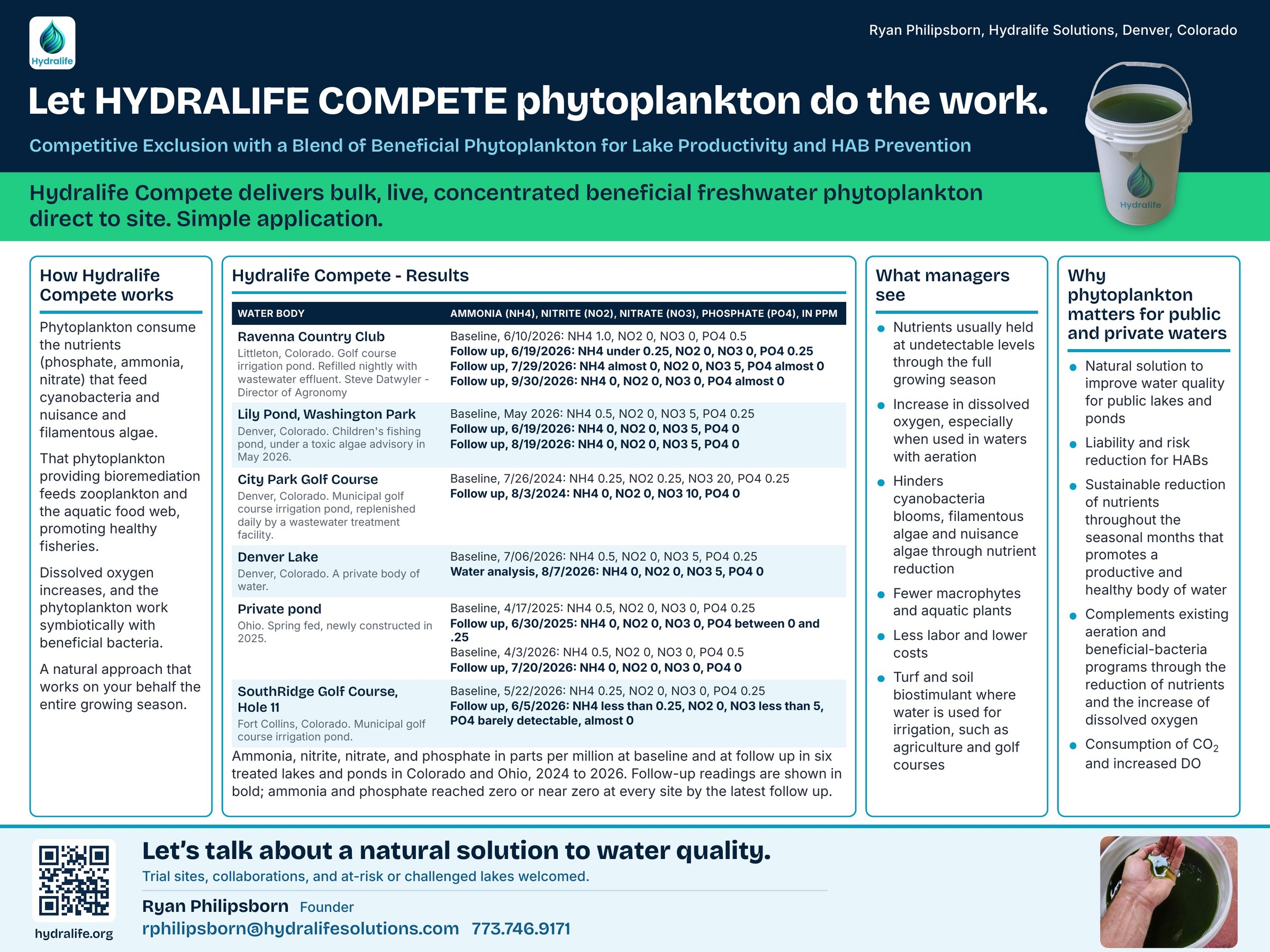
Select the poster to open it at full resolution.
Hydralife presented a poster at the 13th U.S. Symposium on Harmful Algae in Cedar Rapids, Iowa, October 25 to 29, 2026. It is listed in the symposium poster directory as poster 11, Poster Session One, under the title "Competitive Exclusion with Beneficial Phytoplankton for Lake Productivity and HAB Prevention."
The poster, headed "Let HYDRALIFE COMPETE phytoplankton do the work," shows ammonia, nitrite, nitrate and phosphate readings at baseline and at follow up for Hydralife Compete, concentrated phytoplankton, at six treated lakes and ponds in Colorado and Ohio from 2024 to 2026. Ammonia and phosphate reached zero or near zero at every site by the latest follow up.
National Algae Association
Hydralife presented to the National Algae Association in February 2026 and November 2026.
IN THE PRESS
Featured coverage


THE PEOPLE BEHIND IT
Decades of aquaculture, applied to open water
Hydralife Solutions grew out of nearly 30 years spent caring for aquatic life. Every credential below comes back to one idea: when you understand how water and its organisms work together, you can let biology do the work.

Ryan Philipsborn, Founder
Hydralife Solutions

Reef keeping and coral propagation
Nearly 30 years of reef keeping and coral propagation: hundreds of coral species propagated and thousands of coral frags produced, in facilities from 1,000 to 10,000 gallons.

Ongoing study
Ongoing study: a personal library of algae and phycology books.
Operations leadership
Director of Operations at a national aquaculture supplier, 2020 to 2023. Led the plant transformation and lean manufacturing program: revenue grew 250 percent over 3 years with the same number of team members, payroll fell 21 percent, and shipping capacity rose 216 percent while the reship rate on live, time-sensitive goods stayed under 2 percent.
Marine copepod production
Nearly tripled weekly marine copepod output there, from 600 to 1,700 units a week, with the same equipment, labor, water and costs. At roughly $33 a unit, that is an estimated $1.89 million more in gross sales a year (1,100 more units a week, 52 weeks). Species produced: Tigriopus californicus, Tisbe biminiensis, Apocyclops panamensis, Oithona colcarva and Euterpina acutifrons.

Macroalgae cultivation
Grew 2,261 lbs of marine macroalgae indoors in Colorado, in closed recirculating saltwater systems (1,100 gallons across 11 tanks). Five species: Chaetomorpha, Ulva lactuca, Caulerpa racemosa, red ogo and pom pom Gracilaria. Among the first landlocked teams in the U.S. to pass one ton.
City of Fort Collins: contributor to the Urban Lakes Water Quality Management team.
From the reef room and the culture room


INDEPENDENT VERIFICATION
Results checked outside Hydralife
Brookside Laboratories, July 2026
In July 2026, Brookside Laboratories, Inc. analyzed water from the Ravenna Country Club irrigation pond and returned ammonia, nitrate and phosphate values at the same levels as Hydralife’s own field testing.
Metropolitan State University of Denver, August 2026
In August 2026, a Metropolitan State University of Denver student took her own sample from the same pond, and it also showed low nutrient levels.
The other field records on this page are Hydralife samples taken on site with a freshwater test kit, with observations from each site’s superintendent, lake manager or owner.
RECOGNITION AND REGISTRATION
State of Colorado grant and federal contractor status

Redacted award determination letter, State of Colorado, May 20, 2026. Program name and award amount withheld.
State of Colorado grant, 2026
State of Colorado grant, 2026: awarded after a competitive, merit-based review by the state’s grant review committee. Hydralife chose not to accept it.
WHERE TO FIND US
Upcoming and recent events

December 8 to 10, 2026: RMRTA Conference and Trade Show
Rocky Mountain Regional Turfgrass Association, 73rd Annual Conference and Trade Show, Loveland, Colorado. Find Hydralife at tabletop 10. Read what Hydralife is bringing.
October 25 to 29, 2026: U.S. Symposium on Harmful Algae
13th U.S. Symposium on Harmful Algae, Cedar Rapids, Iowa. Hydralife presented a poster of field nutrient results.
February and November 2026: National Algae Association
Hydralife presented to the National Algae Association in February 2026 and November 2026.
RESOURCES
Downloads and further reading
Downloads
5 QUESTIONS
Questions about Hydralife’s research
How does Hydralife measure results?
Hydralife measures ammonia, nitrite, nitrate and phosphate in parts per million before treatment and again afterward, on site, with a freshwater test kit. Each record lists the baseline reading, the follow up readings, the dates and the water source. A reading of 0 means below what a field kit can detect.
Has Hydralife been independently verified?
At Ravenna Country Club, yes. In July 2026, Brookside Laboratories returned ammonia, nitrate and phosphate values at the same levels as Hydralife’s own field testing. The other records are Hydralife field samples taken on site.
Where has Hydralife presented its work?
Hydralife presented a poster at the 13th U.S. Symposium on Harmful Algae in Cedar Rapids, Iowa, in October 2026, and presented to the National Algae Association in February and November 2026. Hydralife is also an exhibitor at the Rocky Mountain Regional Turfgrass Association conference in Loveland, Colorado, December 8 to 10, 2026.
Is Hydralife a registered federal contractor?
Yes. Hydralife Solutions Inc. is registered in SAM.gov under CAGE code 1Z3G6 and UEI ZG53VYPVNYU3, and is listed in the U.S. Small Business Administration’s Small Business Search.
How is Hydralife different from algaecides?
Algaecides kill. Hydralife starves. Hydralife Compete, concentrated phytoplankton, consumes the ammonia, nitrite, nitrate and phosphate that algae and cyanobacteria depend on, 24-7, and outcompetes them for it. It thrives in high-nutrient water, so the excess nutrients become its food source.
GET STARTED
See what your water is feeding
Tell us about your pond or lake and Hydralife will test its ammonia, nitrite, nitrate and phosphate at no cost.
service@hydralifesolutions.com, 303.219.0623